Chemical peels all year round: why active ones are carried out in autumn and winter
Chemical peels are now performed year-round. In summer, superficial peels with mandatory photoprotection are chosen, and more active ones, superficial-medium and medium, are recommended in autumn and winter. The reason is the sun: ultraviolet radiation on the skin after peeling can provoke the appearance of pigmentation. Let's look at what peelings are, why the season is important for deeper peels, how to prepare for the procedure, how to care for your skin after, and for whom peelings are contraindicated.
What is a chemical peel, and which types are available?
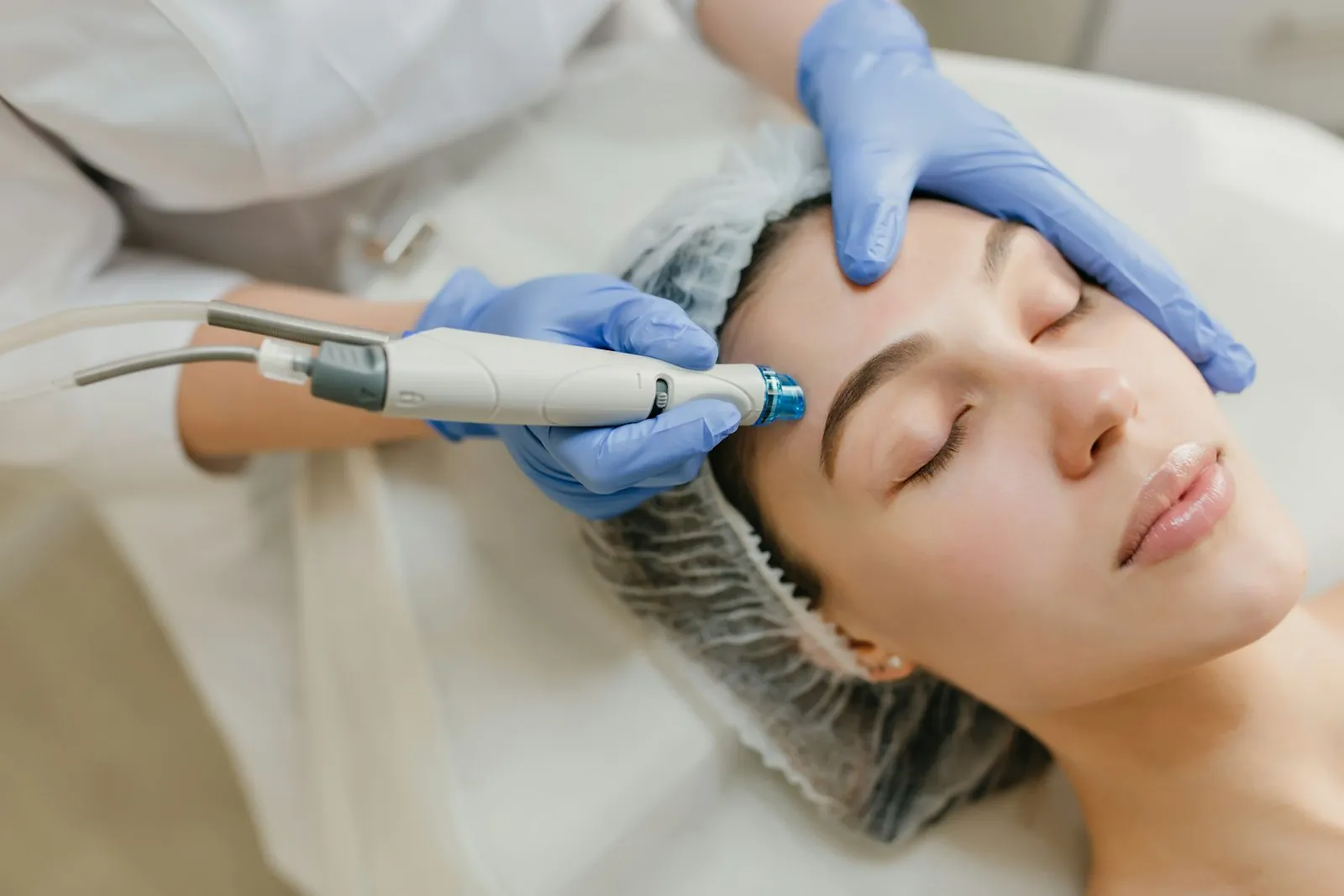
Chemical peeling: application to the skin of an acid or a combination composition that acts on the surface layers of the skin to a specified depth. The skin responds with healing: the surface layer of the skin is renewed, and collagen production in the dermis (middle layer of the skin) increases. The result, recovery time and risks depend on the depth of exposure.
Based on the depth of impact, peelings are divided into three groups:
- Superficial. Act within the epidermis (surface layer of the skin): glycolic, salicylic, lactic, mandelic acid, trichloroacetic acid in low concentrations. The skin recovers in 3–5 days, redness and peeling are easily tolerated or may be absent altogether
- Superficial-medial. They affect the entire thickness of the epidermis to the border with the dermis. Recovery takes longer than after a superficial peel
- Median. They reach the upper (papillary) layer of the dermis, most often it is trichloroacetic acid about 35%. Recovery lasts 7–10 days, swelling increases by the second day
Peels are used for acne and post-acne (acne marks), pigmentation, melasma, uneven tone and signs of photoaging (skin changes caused by the sun).
Is it possible to do peelings in summer?
Nowadays peelings are carried out all year round. Even in summer, peelings can be carried out, improving the quality of the skin: during this period, superficial peels are chosen, including special formulations that can be used during the solar season. If photoprotection is observed, the risk of undesirable consequences for such peels is low.
It is mandatory to use a sunscreen with an SPF filter: every day, throughout the course and after it.
Why deeper peels are recommended in the autumn-winter period
Any peeling temporarily reduces the protective properties of the skin: the stratum corneum is thinned or removed, underneath it there is controlled inflammation, which triggers renewal. If such skin is exposed to ultraviolet light, melanocytes (cells that produce pigment) respond by producing excess melanin. This is how post-inflammatory hyperpigmentation occurs: persistent spots of pigmentation in place of healed areas.
This is the main risk of peelings, and it is highest in people with dark and easily tanned skin (Fitzpatrick phototypes IV–VI). Fair-skinned people are less likely to develop pigmentation, but it is not impossible, especially if their skin is already prone to it.
These spots can remain on the skin for a long time. In some cases, there is a risk that the pigment will remain forever. Exposure to ultraviolet radiation provokes the appearance of more persistent and deeper pigmentation.
Due to the fact that in the summer our skin is exposed to more sun (on the way to work, lunch on the terrace, relaxing in the country), it can be difficult to control the effectiveness of photoprotection. Therefore, more active peelings are recommended to be carried out in seasons with the least solar activity.
Peels for pigmentation and melasma
Peels are often prescribed to correct pigmentation: post-inflammatory hyperpigmentation after acne, solar lentigo (pigment spots associated with photoaging), melasma. Melasma appears as symmetrical patches of pigmentation on the cheeks, forehead and upper lip and is associated with hormonal levels and exposure to light. For melasma, peelings are considered the second line of therapy, after external agents and photoprotection.
At the same time, peeling, which accelerates the removal of pigment, can cause new inflammation and new pigmentation if the skin is irritated. Therefore, for pigmentation, superficial peels are chosen and the course is carried out only against the background of daily photoprotection, preferably in the autumn-winter period.
Autumn and winter in St. Petersburg: why SPF is still needed
St. Petersburg is located on the 60th parallel, and in winter the sun rises low above the horizon. According to climatic data, the maximum UV index in the city from November to February ranges from 0–2, in October and March it does not exceed 1–3, and in summer it reaches 5–7.
According to World Health Organization criteria, healthy skin with a UV index below 3 does not require special protection. For skin after peeling, this rule does not apply: the stratum corneum is thinned, and the skin reacts even to weak ultraviolet radiation. Therefore, a broad spectrum sunscreen after peeling is applied daily, regardless of the season.
With melasma, there is another reason not to give up photoprotection in winter: pigmentation is supported not only by ultraviolet radiation, but also by visible light. Therefore, for melasma, tinted products with iron oxides are recommended, which also block visible light.
How to Prepare for a Peel
Preparation begins in advance: both the result and the risk of complications depend on it.
- Sunscreen every day, starting 1-2 months before treatment
- Preparatory care 2-4 weeks: topical retinoids or special formulations smooth the stratum corneum so that the peel penetrates evenly. They are canceled 3–5 days before the procedure
- For dark skin or a tendency to pigmentation, the doctor may add depigmenting agents (suppressing melanin production)
- If you have herpes on the lips, warn your doctor: peeling can provoke an exacerbation, and antiviral prophylaxis is prescribed before mid-peelings
The composition of the preparation depends on the phototype, task and depth of peeling, so the doctor draws up the scheme during the examination.
How to care for your skin after
After superficial peeling, slight redness and moderate peeling (sometimes just dry skin) are noted, the skin recovers in 3 to 5 days. After a medium peel, recovery lasts 7–10 days. During this period, it is important to follow four rules.
- Do not remove flaky particles or crusts or rub the skin: this increases the risk of scarring and post-inflammatory hyperpigmentation
- Use gentle cleansers and moisturize skin
- Do not sunbathe or visit a solarium, apply SPF daily; After medium peeling, completely avoid exposure to the sun until healing occurs.
- Do not use decorative cosmetics before your doctor allows
How many treatments are needed and at what intervals
The standard recommended course of superficial peels is 4-7 procedures with an interval of 7-10 days. Based on this, the course takes from 3 weeks to 2 months. Medium peels are performed less frequently; the number of procedures and the interval between them is determined by the doctor individually. A course of more active peelings, started in October, can be completed before the spring rise in solar activity: in St. Petersburg, the UV index again reaches 3 in April.
The doctor chooses the depth of exposure, peeling composition, active ingredient and number of procedures according to the condition of the skin: for active acne, post-acne and melasma, the schemes differ.
For whom peelings are contraindicated
Some restrictions are absolute, some depend on the depth of peeling and are decided at the appointment.
- Pregnancy and breastfeeding: there is little safety data, medium peels are excluded, the doctor makes a superficial decision
- Herpes in the active phase, bacterial and fungal infections of the skin in the procedure area
- Tendency to keloid and hypertrophic scars
- Immunodeficiency conditions, including HIV infection
- Major transactions in the last 6 months
- Exacerbation of rosacea, atopic or seborrheic dermatitis, facial psoriasis
- Working in the sun when photoprotection is not possible
- Dark skin of phototypes IV–VI: superficial peels are possible, medium peels are carried out with caution due to the risk of permanent changes in skin color
Separate question: systemic isotretinoin (a drug for the treatment of severe forms of acne). Previously it was believed that after the course you need to wait at least six months. It is now known that there is no need to delay superficial peels during and immediately after treatment, but caution remains for midline peels. If you are taking or have recently taken isotretinoin, tell your doctor.
When it's time to see a doctor
Peeling should be discussed with a dermatologist if you are concerned about post-acne, uneven tone, pigmentation, the first signs of photoaging, or acne that does not respond to home care. During the examination, the doctor will determine the phototype, exclude contraindications and select the type of peeling and course regimen. The best time for this is autumn and winter.
A special reason for a visit: fresh pigmentation spots that appeared this summer. The sooner you start treatment, the higher the chance that the pigment will go away faster and almost without a trace.
Clinic servicesChemical peels · Treatment of hyperpigmentation · Consultation with a dermatologist
The material is for informational purposes only and does not replace medical advice. There are contraindications, consultation with a specialist is required.
Sources
- Rendon M.I., Berson D.S., Cohen J.L. et al. Evidence and Considerations in the Application of Chemical Peels in Skin Disorders and Aesthetic Resurfacing. Journal of Clinical and Aesthetic Dermatology, 2010. pmc.ncbi.nlm.nih.gov
- Castillo D.E., Keri J.E. Chemical peels in the treatment of acne: patient selection and perspectives. Clinical, Cosmetic and Investigational Dermatology, 2018. pmc.ncbi.nlm.nih.gov
- Spring L.K., Krakowski A.C., Alam M. et al. Isotretinoin and Timing of Procedural Interventions: A Systematic Review With Consensus Recommendations. JAMA Dermatology, 2017. pubmed.ncbi.nlm.nih.gov
- American Academy of Dermatology. Chemical peels: FAQs. aad.org
- Davis E.C., Callender V.D. Postinflammatory Hyperpigmentation: A Review of the Epidemiology, Clinical Features, and Treatment Options in Skin of Color. Journal of Clinical and Aesthetic Dermatology, 2010. pmc.ncbi.nlm.nih.gov
- Ogbechie-Godec O.A., Elbuluk N. Melasma: an Up-to-Date Comprehensive Review. Dermatology and Therapy, 2017. pmc.ncbi.nlm.nih.gov
- World Health Organization. Radiation: The ultraviolet (UV) index. Q&A. who.int-index)
- Weather2Travel. St Petersburg climate: average weather, UV index and sunshine by month. weather2travel.com