Laser hair removal in autumn and winter: why the season matters
It is recommended to start a course of laser hair removal in the fall. During the season with the least solar activity, the skin is not tanned, after the procedure it is easier to avoid the sun, and the risk of burns and pigmentation is lower. We will analyze how the laser works, how many procedures are needed and at what intervals, how to prepare, how to care for the skin after the procedure, to whom it is contraindicated, and when excess hair growth requires consulting a doctor.
How laser hair removal works
The method is based on selective photothermolysis (selective heating): light of a certain wavelength is absorbed by melanin, the pigment of the hair shaft, its epithelium and matrix (growth zones in the follicle). The pigment heats up, and the heat damages the follicle structures responsible for hair growth, and the surrounding skin, with correctly selected parameters, is minimally damaged.
Several types of light sources are used for hair removal: diode, alexandrite and neodymium lasers, as well as IPL (broadband pulsed light). They operate in the red and near-infrared wavelengths and vary in penetration depth and how strongly their radiation is absorbed by skin melanin. Neodymium laser is less absorbed by skin pigment, so it is more often chosen for dark skin. The doctor selects the type of device and parameters based on skin phototype, hair color and thickness.
Purpose of the procedure: long-term hair reduction. Complete and permanent removal of all hair has not been confirmed by research. Some hair may grow back over time, usually becoming thinner and lighter in color, and maintenance treatments may be needed to maintain results.
Because the target is pigment, dark, coarse hair on fair skin responds well to the laser. Blonde, gray and white hair contains little melanin and practically does not respond to the procedure.
Why the Season Matters: Tanning, Burns and Pigmentation
Melanin is found not only in hair, but also in skin. The more pigment in the skin, the more energy it absorbs and the higher the risk of burning, and then post-inflammatory hyperpigmentation or hypopigmentation (lightening areas). Therefore, dark and especially tanned skin is at a higher risk of pigmentary changes.
A fresh tan increases this risk, and if the skin is tanned, the procedure is rescheduled or performed with modified parameters. After the procedure, the skin is also protected from the sun: direct sun on the treated area can cause pigmentation.
In autumn and winter, there is no or minimal tanning, and avoiding the sun after the procedure is easier than in summer. A course of several procedures at intervals of several weeks, started in the fall, can usually be carried out during the period with the least solar activity.
How many treatments are needed and at what intervals
Laser hair removal is carried out in a course. This is due to the hair growth cycle: the laser acts more effectively on hair in the active growth phase (anagen), and at any given moment only part of the hair is in this phase.
According to the American Academy of Dermatology, most patients require 2 to 6 treatments, with some areas requiring 6 or more. The interval between procedures is most often 4–6 weeks. The doctor determines the exact number of procedures and interval individually: they depend on the area, hair color and thickness, skin phototype and hormonal levels.
On women's faces, hair growth largely depends on hormones, so the results are less permanent and maintenance procedures are more often required.
How to prepare for the procedure
- Do not sunbathe in the sun or in a solarium, do not use self-tanner
- Apply a broad-spectrum sunscreen with SPF 30 or higher daily if the treated area is exposed to the sun
- From the beginning of the course, do not pluck, wax, sugar, electrolysis or bleach the hair in the treatment area: these methods remove or lighten the hair that serves as a target for the laser. Shaving is allowed
- Shave the hair in the treatment area the day before the visit: by the time of the procedure, the hair length should be 1-5 mm
- Tell your doctor if you are prone to herpes (if frequent relapses, antiviral prophylaxis is prescribed), keloids (dense growths of scar tissue) or a tendency to them, if you have a fresh tan, if you are taking isotretinoin (a drug for the treatment of severe forms of acne) and any other medications, including over-the-counter ones
At the discretion of the doctor, a test treatment of a small area of skin may be carried out before the course: it helps to select parameters and assess tolerability.
Feelings during the procedure
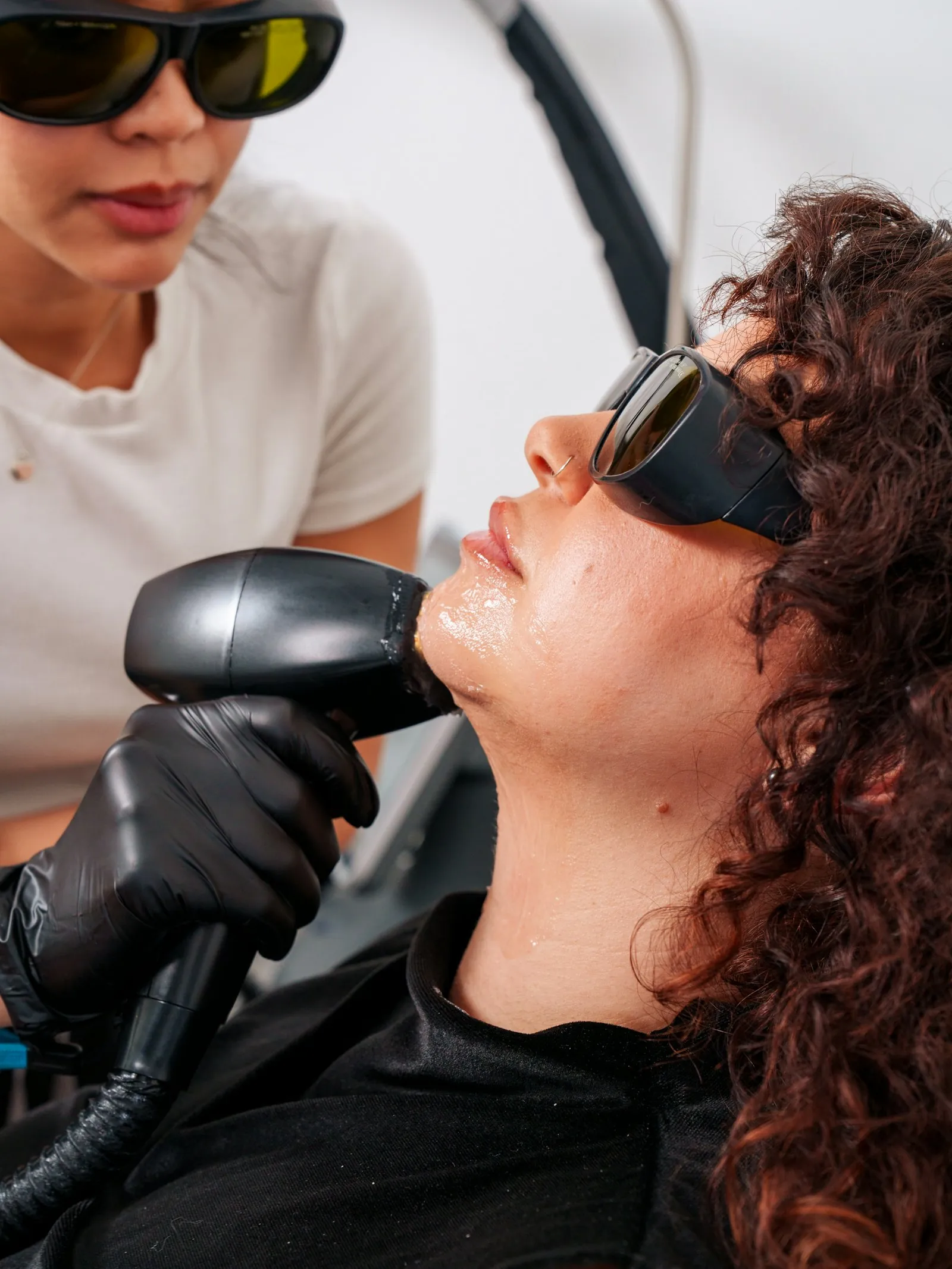
The sensation is described as tingling or warmth. To reduce discomfort, skin cooling is used: built into the device, cooling gel or cold compresses after the procedure. During the procedure, the patient and doctor wear protective glasses.
Post-procedure care
Immediately after the procedure, perifollicular erythema (redness around the hair follicles) and swelling appear. They resemble a mild sunburn and usually go away in 1–3 days. A cold compress can help relieve discomfort.
- Avoid direct sun on the treated area, do not visit a solarium
- Apply sunscreen daily
- Do not injure the skin in the treatment area
Call your doctor if you notice blisters, crusts, or pain that doesn't go away.
Other side effects are rare if the indications and parameters are followed: blisters, exacerbation of herpes, infection, scarring, lightening or darkening of the skin. Hyperpigmentation is usually temporary, but in rare cases, changes in skin color are permanent.
Isolated rare complication: paradoxical hypertrichosis (increased hair growth in or near the treated area). It is most often described on the face and neck, in patients with dark skin, dark thick hair and hormonal imbalances.
For whom laser hair removal is contraindicated
The procedure is not performed:
- During pregnancy: elective cosmetic procedures are postponed until after birth
- In case of active skin infection in the procedure area, including an exacerbation of herpes
- For diseases that are aggravated by light, such as systemic lupus erythematosus
- For keloid scar in the procedure area
The procedure is performed with caution and only after consulting a doctor:
- If you are prone to keloid scars
- For a fresh tan
- For cuts and damaged skin in the treatment area
- If you are taking medications that make your skin more sensitive to light (such as minocycline)
- For psoriasis and vitiligo: due to the risk of Koebner phenomenon (the appearance of new lesions at the site of skin injury)
Isotretinoin. Previously it was believed that after the course you need to wait several months. According to a systematic review and consensus of dermatologists, there is no sufficient evidence to justify delaying laser hair removal during and after treatment with isotretinoin. The doctor makes the decision.
When excessive hair growth is a reason to consult a doctor
Laser hair removal removes hair, but not the cause of excess hair growth. If hair grows according to the male pattern (hirsutism: coarse dark hair on the chin, above the upper lip, on the chest, abdomen, back), especially in combination with menstrual irregularities, acne or hair loss on the head, or excess growth began suddenly and grows quickly, you need to consult a gynaecologist-endocrinologist before epilation. Such signs may indicate hyperandrogenism (excess male sex hormones), including polycystic ovary syndrome.
The doctor evaluates the severity of hirsutism using the Ferriman-Gallwey scale and, if necessary, prescribes an examination. If the cause is hormonal imbalance, hair removal is carried out during treatment, otherwise the hair will grow back.
At the consultation before the course, the doctor determines the phototype, evaluates the color and thickness of the hair, excludes contraindications and selects the type of device, parameters and course scheme.
Clinic servicesLaser hair removal · Consultation with a dermatologist · Consultation with a gynaecologist
The material is for informational purposes only and does not replace medical advice. There are contraindications, consultation with a specialist is required.
Sources
- Anderson R.R., Parrish J.A. Selective photothermolysis: precise microsurgery by selective absorption of pulsed radiation. Science, 1983;220(4596):524–527. pubmed.ncbi.nlm.nih.gov
- Vaidya T., Hohman M.H., Kumar D.D. Laser Hair Removal. StatPearls, 2023. ncbi.nlm.nih.gov
- Gan S.D., Graber E.M. Laser hair removal: a review. Dermatologic Surgery, 2013;39(6):823–838. pubmed.ncbi.nlm.nih.gov
- Haedersdal M., Wulf H.C. Evidence-based review of hair removal using lasers and light sources. Journal of the European Academy of Dermatology and Venereology, 2006;20(1):9–20. pubmed.ncbi.nlm.nih.gov
- Haedersdal M., Gøtzsche P.C. Laser and photoepilation for unwanted hair growth. Cochrane Database of Systematic Reviews, 2006;(4):CD004684. pubmed.ncbi.nlm.nih.gov
- Drosner M., Adatto M.; European Society for Laser Dermatology. Photo-epilation: guidelines for care from the European Society for Laser Dermatology (ESLD). Journal of Cosmetic and Laser Therapy, 2005;7(1):33–38. pubmed.ncbi.nlm.nih.gov
- Buddhadev R.M.; IADVL Dermatosurgery Task Force. Standard guidelines of care: Laser and IPL hair reduction. Indian Journal of Dermatology, Venereology and Leprology, 2008;74 Suppl:S68–S74. ijdvl.com
- Lim S.P., Lanigan S.W. A review of the adverse effects of laser hair removal. Lasers in Medical Science, 2006;21(3):121–125. pubmed.ncbi.nlm.nih.gov
- Desai S., Mahmoud B.H., Bhatia A.C., Hamzavi I.H. Paradoxical hypertrichosis after laser therapy: a review. Dermatologic Surgery, 2010;36(3):291–298. pubmed.ncbi.nlm.nih.gov
- Spring L.K., Krakowski A.C., Alam M. et al. Isotretinoin and Timing of Procedural Interventions: A Systematic Review With Consensus Recommendations. JAMA Dermatology, 2017;153(8):802–809. pubmed.ncbi.nlm.nih.gov
- Lee K.C., Korgavkar K., Dufresne R.G., Higgins H.W. Safety of cosmetic dermatologic procedures during pregnancy. Dermatologic Surgery, 2013;39(11):1573–1586. pubmed.ncbi.nlm.nih.gov
- American Academy of Dermatology. Laser hair removal: FAQs. aad.org
- American Academy of Dermatology. Laser hair removal: Preparation. aad.org
- American Academy of Dermatology. Laser hair removal: Overview. aad.org
- Russian Society of Obstetricians and Gynecologists, Russian Association of Endocrinologists. Clinical guidelines “Polycystic ovary syndrome”, ID 258. Ministry of Health of Russia, 2021. legalacts.ru
- Teede H.J., Tay C.T., Laven J.J.E. et al. Recommendations from the 2023 International Evidence-based Guideline for the Assessment and Management of Polycystic Ovary Syndrome. Human Reproduction, 2023. doi.org