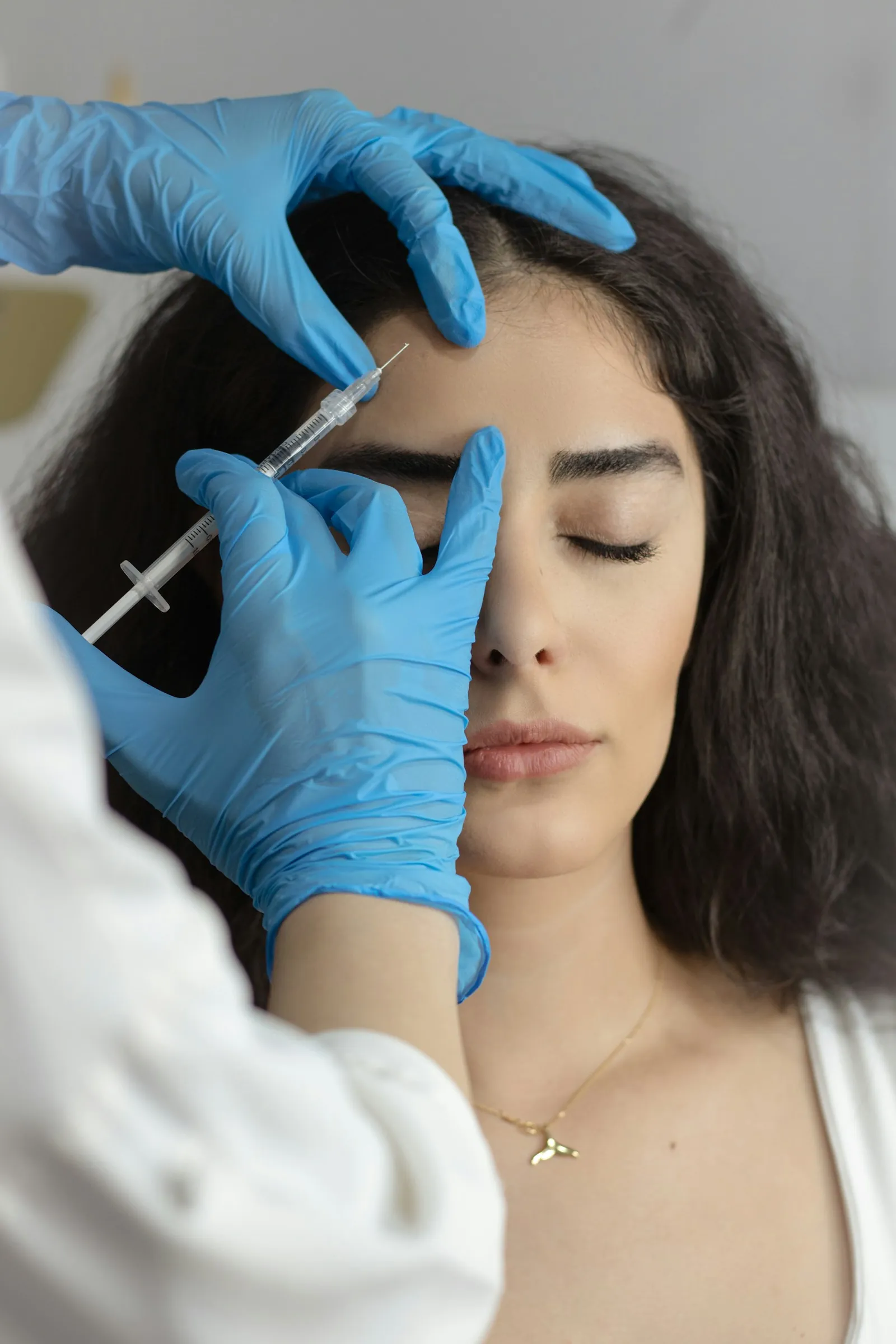
Botulinum therapy: what is important to know before the first procedure
Botulinum therapy corrects facial wrinkles, which are formed by muscle hypertonicity (excessive tension in the facial muscles). In the article: how botulinum toxin type A works, when the effect develops and how long it lasts, what side effects there are, for whom the procedure is contraindicated, how to prepare for it and why a follow-up visit is needed in two weeks.
How botulinum toxin affects facial muscles
Wrinkles between the eyebrows, on the forehead and at the outer corners of the eyes form where the facial muscles contract repeatedly in one direction. The skin over them constantly folds, and over time the fold remains even at rest.
Botulinum toxin type A does not act on the skin, but on the transmission of nerve impulses to the muscle. The nerve transmits the signal to contract using acetylcholine (a mediator substance). The drug injected into the muscle blocks the release of acetylcholine from the nerve ending, the muscle relaxes, and the skin over it stops wrinkling.
The effect is reversible: the nerve ending gradually restores signal transmission. Therefore, the procedure is repeated.
When is the effect visible and how long does it last?
The first changes are noticeable after 2–3 days, in some patients within a day. Complete relaxation of the muscle develops in 5–15 days, so the result is assessed no earlier than after two weeks.
In the official instructions for the drugs, the duration of the effect is 3-4 months, repeated administration is recommended no earlier than 12 weeks after the first injection. The duration depends on the zone, dose, muscle activity and individual characteristics. The effect stops smoothly, and facial activity returns to its original state.
Will the face become a mask?
The concern that the face will lose mobility stems from early practice when the drug was administered in large doses. Now the goal of the procedure is to remove muscle hypertonicity while maintaining natural muscle mobility. To do this, the facial anatomy is assessed and an individual correction scheme is selected for a particular patient.
During the consultation, the doctor evaluates facial expressions in motion and determines which muscles require correction. If you want to maintain pronounced facial expressions, please let us know: this is taken into account when calculating the dose.
The effect of the administered drug cannot be reversed; the effect weakens gradually. Therefore, for the first treatment, a lower dose is preferred, with an assessment after two weeks, when the drug can be added if necessary.
Does the body get used to botulinum toxin
“Habituation” usually refers to a decrease in effect with repeated treatments. One reason: the production of neutralizing antibodies (the immune system recognizes the toxin protein and binds it before it reaches the nerve ending).
In aesthetic cosmetology, where small doses are used, antibodies are practically not detected. To keep the risk low, follow the principle from the instructions: the minimum effective dose and the interval between procedures is at least 12 weeks. Additional administrations before the effect has worn off are not recommended.
How safe is it: side effects
Most common:
- Bruising or soreness at the injection site: resolves within a few days
- Headache in the first days after the procedure
- Drooping of the eyebrow or eyelid (ptosis): the drug spreads to the adjacent muscle. Ptosis is rare and its incidence depends on the insertion technique. It is temporary and goes away as the effect of the drug wears off.
Serious reactions at cosmetic doses have not been reported in studies. The warning in the instructions about the spread of the toxin (general weakness, difficulty swallowing or breathing) concerns primarily large therapeutic doses, which are used by doctors of related specialties (neurologists) to treat severe spastic conditions of the whole body.
For whom botulinum therapy is contraindicated
Contraindications for use according to instructions:
- Acute diseases (the drug is administered after recovery)
- Pregnancy
- Lactation period (breastfeeding)
- Hypersensitivity to the components of the drug
Use of the drug during pregnancy and breastfeeding is contraindicated. No studies have been conducted on the effect of the drug on reproductive function and teratogenicity (risk of fetal malformations); the safety of use during pregnancy and breastfeeding has not been confirmed.
In elderly patients with reduced muscle mass, the dose of the drug may be reduced. The procedure is also carried out in case of inflammation or infection of the skin in the injection area.
Tell your doctor if you have been diagnosed with a disorder of neuromuscular transmission (myasthenia gravis, Lambert-Eaton syndrome, amyotrophic lateral sclerosis) or if you are taking aminoglycoside antibiotics or muscle relaxants: in these cases, the effect of the toxin may be increased. Blood thinners and nonsteroidal anti-inflammatory drugs (such as ibuprofen) are not contraindicated, but they increase the likelihood of bruising.
How to prepare and what not to do afterwards
Come with no sore skin in the injection area and a list of the medications and supplements you are taking (including omega-3s and aspirin: these also thin the blood). If there is an important event ahead, the procedure is planned 2-3 weeks in advance: by this time the effect will be fully formed, and possible bruises will disappear.
After the procedure, it is recommended not to take a horizontal position for 4 hours, not to touch or massage the injection area, and to avoid sports, baths and saunas for 24 hours. Applying cold to the injection area immediately after the procedure reduces swelling and the likelihood of bruising.
Botulinum toxin for sweating
The sweat glands receive a signal from the nerves through the same acetylcholine, so botulinum toxin is also used for hyperhidrosis (excessive sweating). The drug is administered intradermally through a grid of points in the axillary region, less often on the palms and soles. Indication: primary hyperhidrosis (excessive sweating not associated with another disease), which cannot be controlled with antiperspirants.
The effect after the first procedure lasts for an average of 6-7 months, with repeated procedures in most patients it lasts longer. Possible side effects: pain at the injection sites, minor hemorrhages, and in some patients, compensatory sweating in other areas.
When it's time to see a doctor
Botulinum therapy is indicated when the main cause of the fold is muscle hypertonicity. If a wrinkle is noticeable at rest, the volume of soft tissues has decreased or their contour has changed, botulinum toxin alone is not enough, and the doctor will discuss this at a consultation. Contraindications are also excluded, facial expressions in motion are assessed and the desired result is determined: softening or complete relaxation of the zone.
A follow-up examination is performed 2 weeks after the procedure. This is the second stage of correction, which is the norm of the procedure. Sometimes you don't need to add anything. If a small dosage is administered after 2 weeks, it is paid according to the number of units administered.
You can book a consultation with an aesthetic physician or directly to botulinum therapy. If you are worried about sweating, see treatment of hyperhidrosis.
Consult your doctor before the check-in date if asymmetry appears, the eyelid droops, or unexpected symptoms occur: weakness, double vision, difficulty swallowing. Such reactions are rare but require immediate attention.
Clinic servicesBotulinum toxin injections · Treatment of hyperhidrosis · Consultation with an aesthetic physician
The material is for informational purposes only and does not replace medical advice. There are contraindications, consultation with a specialist is required.
Sources
- Camargo C.P., Xia J., Costa C.S. et al. Botulinum toxin type A for facial wrinkles. Cochrane Database of Systematic Reviews, 2021. pmc.ncbi.nlm.nih.gov
- Nestor M., Cohen J.L., Landau M. et al. Onset and Duration of AbobotulinumtoxinA for Aesthetic Use in the Upper Face: A Systematic Literature Review. Journal of Clinical and Aesthetic Dermatology, 2020. jcadonline.com
- Sundaram H., Signorini M., Liew S. et al. Global Aesthetics Consensus: Botulinum Toxin Type A. Evidence-Based Review, Emerging Concepts, and Consensus Recommendations for Aesthetic Use, Including Updates on Complications. Plastic and Reconstructive Surgery, 2016. pmc.ncbi.nlm.nih.gov
- Jankovic J., Carruthers J., Naumann M. et al. Neutralizing Antibody Formation with OnabotulinumtoxinA Treatment from Global Registration Studies across Multiple Indications: A Meta-Analysis. Toxins, 2023. pmc.ncbi.nlm.nih.gov
- U.S. Food and Drug Administration. Prescribing information: onabotulinumtoxinA for injection (sections 4, 5, 6.2, 7, 8, 14.6), 2017. accessdata.fda.gov
- Sun J. et al. Efficacy and Safety of Botulinum Toxin Type A in Primary Axillary Hyperhidrosis: A Meta-analysis and Systematic Review. Aesthetic Plastic Surgery, 2025. pmc.ncbi.nlm.nih.gov
- Berthin C., Maillard H. Duration of Efficacy Increases with the Repetition of Botulinum Toxin A Injections in Primary Axillary Hyperhidrosis: A 15-year Study in 117 Patients. Acta Dermato-Venereologica, 2020. medicaljournals.se
- Instructions for the medical use of botulinum toxin type A preparations. State register of medicines. grls.rosminzdrav.ru